
How the Thurston County Court Calendar Works
The Thurston County Superior Court main-campus calendar does more than list cases. It posts session availability for the next 90 days. Daily courtroom assignments and remote-hearing details appear too. Non-trial weeks, holidays, confirmed criminal trial lists, and civil trial dates round it out. A session marked closed is usually full. Still, a judge can add a matter by court order. So closed does not rule out every hearing on that date.
The Thurston County court schedule divides by subject. It also divides by location. Main-campus sessions handle much of the Superior Court work in Olympia. Family, juvenile, dependency, adoption, and probate settings live on the Family and Juvenile Court calendar. So do guardianship and involuntary-treatment settings. For District and municipal dates, turn elsewhere. Use the real-time statewide date tool, the District Court virtual calendar, or the court clerk. Remember what a calendar is: a scheduling source. It never replaces a filed Notice of Hearing or a signed order.
The county's own main-campus page shows how these groupings are organized:
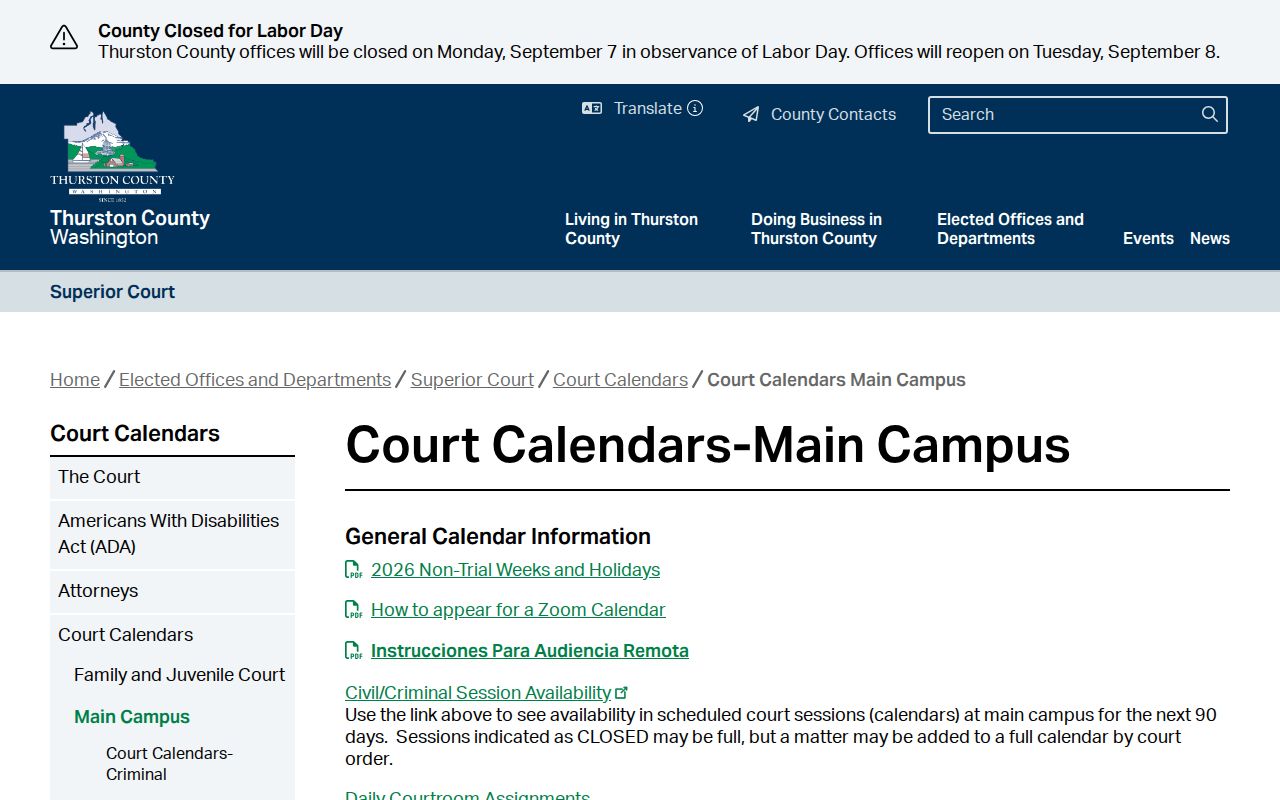
That view covers session status and courtroom assignments, while the case hearing entry gives the setting tied to one case.
Thurston County Court Date Chain
A solid Thurston County court calendar check follows a fixed chain. Begin in the case record, not a broad web search. Superior Court matters can be searched in Odyssey. It includes a hearing search. District and municipal settings can be checked in Washington Courts Find My Court Date. That tool queries the same live transactional database court staff use. Then compare the result against the county calendar. Also check the latest filed notice.
When sources disagree, write down both results and the time you checked. A calendar can shift after a daily index refresh. A filed continuance may post before every public screen catches up. The court responsible for the case is the final contact. For more on locating the case first, use the Thurston County docket search.
Best sequence: Case docket → hearing search → published court calendar → latest notice → clerk confirmation.
Thurston County Court Date Lookups
A Thurston County court date search goes fastest when the court and case number are already known. Each court level has its own channel. No single screen promises that a setting will proceed, so use whichever channel fits the case.
- Read the notice or citation and identify Superior Court, District Court, or the named municipal court.
- For Superior Court, search the case in Odyssey Search Hearings by case number, party, attorney, judicial officer, courtroom, or date range.
- For District or municipal court, use Find My Court Date with the court, first name, and last name.
- Compare the result with the county's daily assignments, criminal list, family and juvenile list, or virtual calendar.
- Review the latest Notice of Hearing and Register of Actions. A reset can make an old listing stale.
- Call the responsible clerk if any field conflicts. Superior Court Administration is 360-786-5560, and District Court is 360-786-5450.
- At court, check the posted daily calendar when available and ask staff about the exact cause number.
Washington's attorney search also sends a daily limited-jurisdiction calendar email. Its help text warns that proceedings can be rescheduled, and it advises calling the court on the morning of the proceeding.
Thurston Criminal Calendar Rhythm
The Thurston County criminal calendar separates events that sound alike. Preliminary appearances, arraignments, competency hearings, and treatment reviews each get their own label. So do change-of-plea and sentencing settings, motions, Drug Court, and trial confirmation. Every label marks a different stage. Trial confirmation deals with readiness and scheduling. It is not the trial itself. A change of plea is one event. Sentencing is another.
The official criminal calendar page shows those setting groups laid out:
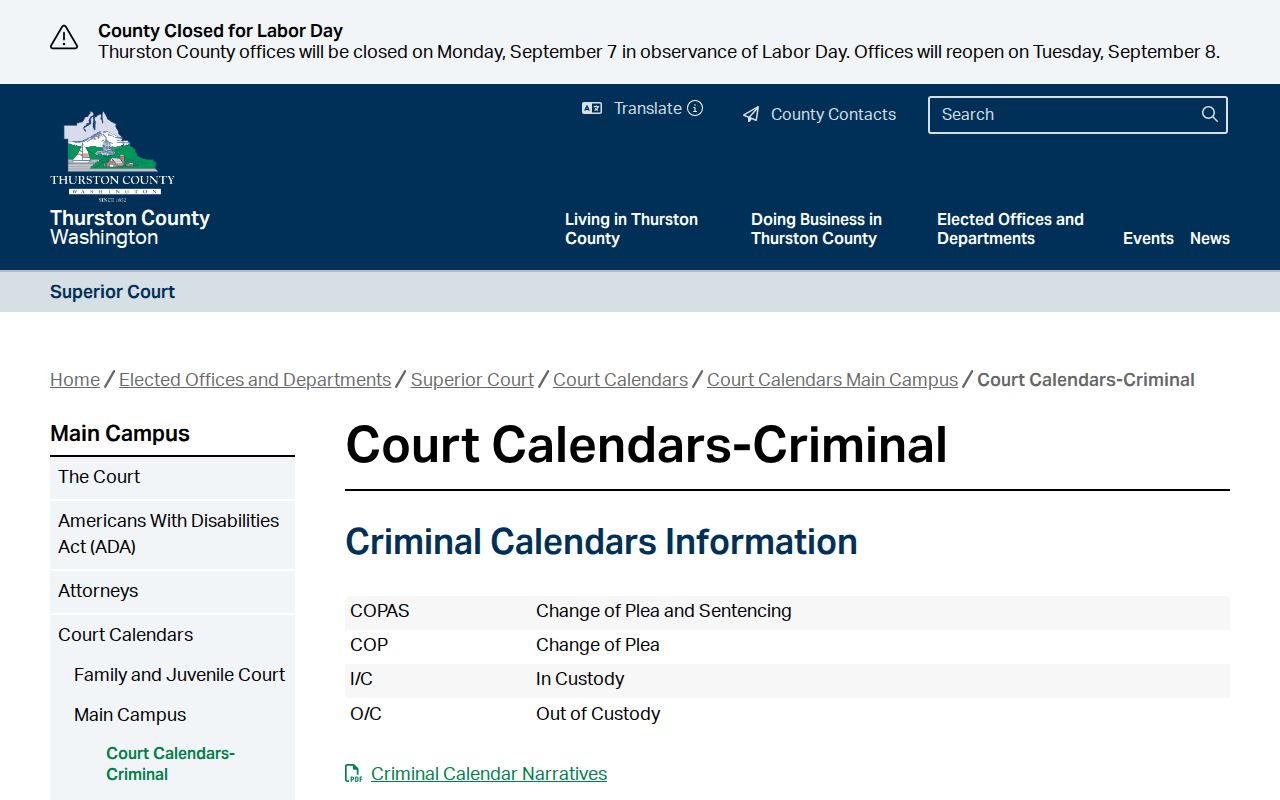
Keeping the exact label matters. It keeps a motion, review, or readiness check from being misread as a final result. A judicial officer may hear, continue, or strike a motion. The docket event plus the later order show what actually happened.
Note: A calendar label describes the scheduled event. It is not the charge outcome or the final status of the whole case.
Thurston Court Settings: Field Meanings
Read any Thurston County court schedule result as a group of linked fields. The date alone tells you little. Match the case number and court first, then note the assigned place, officer, setting type, and attendance instructions.
| Date and time | The scheduled start. Check again near the hearing because the time can move. |
|---|---|
| Court and location | Superior, District, or municipal court and the campus or online calendar responsible for the case. |
| Courtroom | The assigned room, which may change through the daily courtroom assignment list. |
| Judicial officer | The judge or commissioner assigned to the calendar, subject to reassignment. |
| Setting type | The purpose, such as arraignment, motion, trial confirmation, probate, or review. |
| Remote details | Zoom link, meeting ID, passcode, and any rule requiring an in-person appearance. |
Many Family and Juvenile Court entries state who may appear remotely and who must come in person. Do not assume a Zoom ID alone grants remote attendance.
Statewide Thurston Calendar Fallback
The standard Washington Courts Case Search helps when the correct court is unclear. A searcher can pick a court level, court name, case type, and filing year. Searches also run by name or case number. Thurston options include District Court plus several municipal or violations labels. That breadth is good for routing a case. But the index refreshes only daily. So it is not the strongest tool for a last-minute setting.
The statewide form shows the court and search controls used for routing:
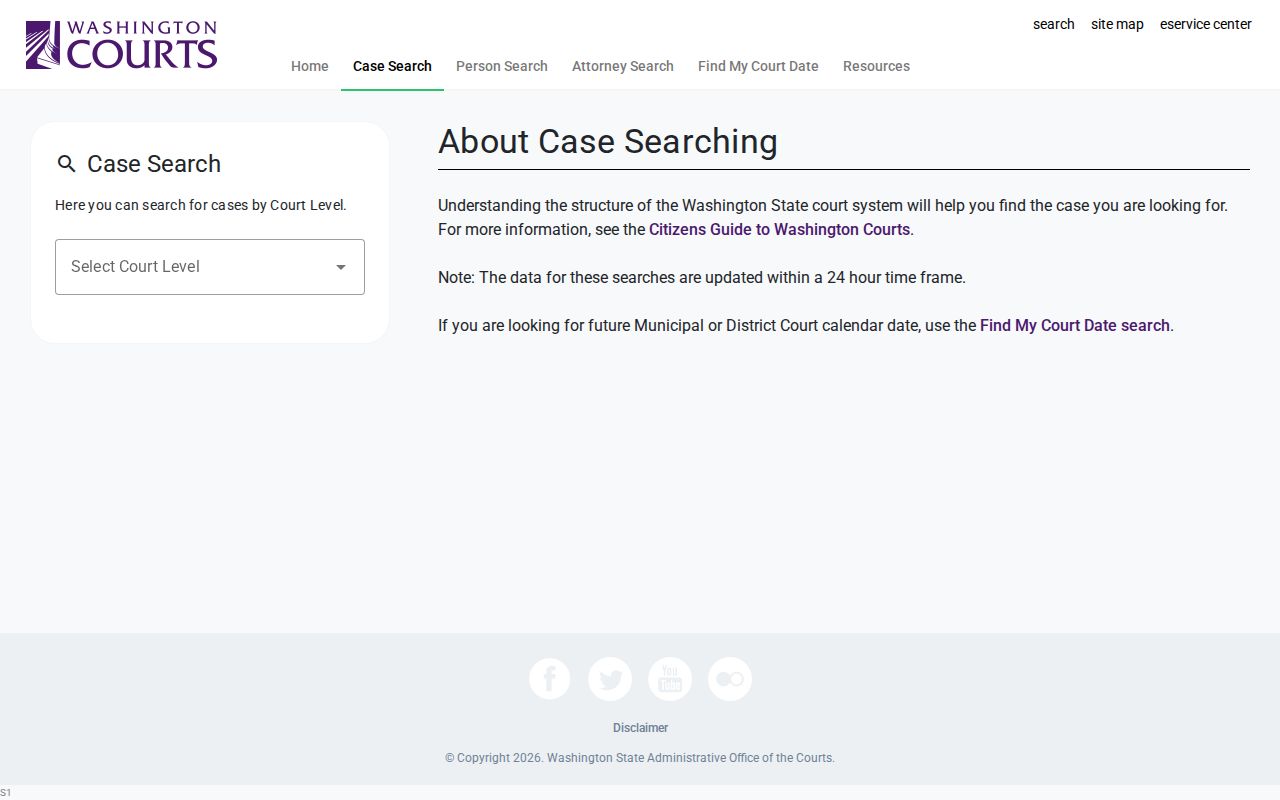
Once the result gives you the court and case number, move to the live date tool or the Thurston County court calendar. The statewide index itself warns that its information can be incomplete.
When a Thurston Court Date Moves
Thurston County dockets use a small vocabulary for moved settings. A continuance pushes a date back. A reset gives it a new time. A stricken setting has come off the calendar entirely. Read none of these words as a dismissal, because none of them is one. Criminal motions in Thurston County may be heard, continued, or stricken at the direction of the judicial officer. Other settings can shift by notice or by written order.
When a court date changes, work from the record rather than memory. Pull the latest notice from Events or the Register of Actions. Then reopen Hearings. Set the new date beside the daily assignment list. Keep the old date in your notes. But treat it as superseded only once an official entry says so. If the docket and the calendar disagree, call the clerk and give the exact cause number.
A full Thurston County calendar can still take a judge-ordered matter. A crowded session proves nothing about any single case.
Thurston Family Court Calendar
Family and Juvenile Court in Thurston County keeps a calendar of its own. Its settings cover shelter care, dependency, adoptions, juvenile detention, family motions, minor guardianship, domestic-violence compliance review, probate, guardianship, involuntary-treatment matters, and Family Recovery Court. The division also sits at a separate location, away from the main Olympia campus. That split matters. Before heading out for a Thurston County court date, confirm which division the case belongs to. Confirm where that division actually hears it, too.
- Shelter care
- An early dependency setting about a child's temporary placement and safety.
- Ex parte
- A request presented for prompt action under rules that may not require a standard noticed hearing.
- Compliance review
- A setting to review whether an order or program requirement has been followed.
- Trial confirmation
- A readiness and scheduling calendar held before a possible trial.
Not everything in a family or juvenile file appears online, since much of it is protected. Seeing a calendar entry does not turn a confidential file into a public one.
Court Settings: What Each Field Means
A setting, a docket event, and a disposition answer three different questions. The setting is a planned court event. The docket event records something filed or done. The disposition records an outcome, while a signed order is the judicial direction as actually filed. The distinctions matter in practice. A sentencing setting can sit on the calendar long before any sentencing order exists, and a continued motion can stay in the Register of Actions even though its old date no longer controls anything.
For a solid Thurston County court calendar note, write down the court, the case number, the setting name, date, time, courtroom, judicial officer, any remote details, the source URL, and the time you searched. Then say whether an index alone showed the setting or a current notice confirmed it. That habit keeps scheduled facts and filed-record facts from blurring together.
Missed Settings and What Comes Next
Missing a Thurston County court setting does not tell you the result by itself. What happens next turns on the case type. It also turns on any order the court has entered. Go back to the official docket and read the newest event and hearing fields. Then call the clerk right away with the case number in hand. Ask whether a new date, an order, a warrant-related event, a default, or some other action now appears. The record alone can answer that question.
Act promptly. A missed setting can have serious case-specific consequences. Contact the responsible court, follow its current directions, and do not rely on an old calendar page.
District Court can be reached at 360-786-5450, and Superior Court administration at 360-786-5560. Staff can explain procedure and calendar information but cannot give legal advice. If the case lists counsel, contact counsel too.