
Thurston County Criminal Docket Searches
Know the court before you type a name. Felony cases in Thurston County go through Superior Court. Misdemeanors and gross misdemeanors go through District Court. Yelm Municipal Court runs a docket of its own. Some other municipal labels point back to District Court anyway. The Washington Courts Case Search is a quick way to pin down both the court and the cause number. After that, Superior Court details show up in Odyssey. District Court files follow a separate county path.
A full cause number beats a name every time. If you only have a name, narrow the search with the court, case type, and filing year. Two people can share one name. So match location, party role, filing date, and attorney where the public record shows them. For anything that must be conclusive, get the clerk's official record or a certified copy.
- Select Superior Court or District and Municipal Courts in the statewide search.
- Choose the exact Thurston County court and Criminal as the case type.
- Search by full cause number, or use the party name with a filing-year limit.
- Open the matching result and compare hearings, events, charges, and disposition entries.
- Ask the correct clerk for a filed order, judgment, or certified copy when the index is not enough.
The official search form shows the court-level and case-type choices used in this process.
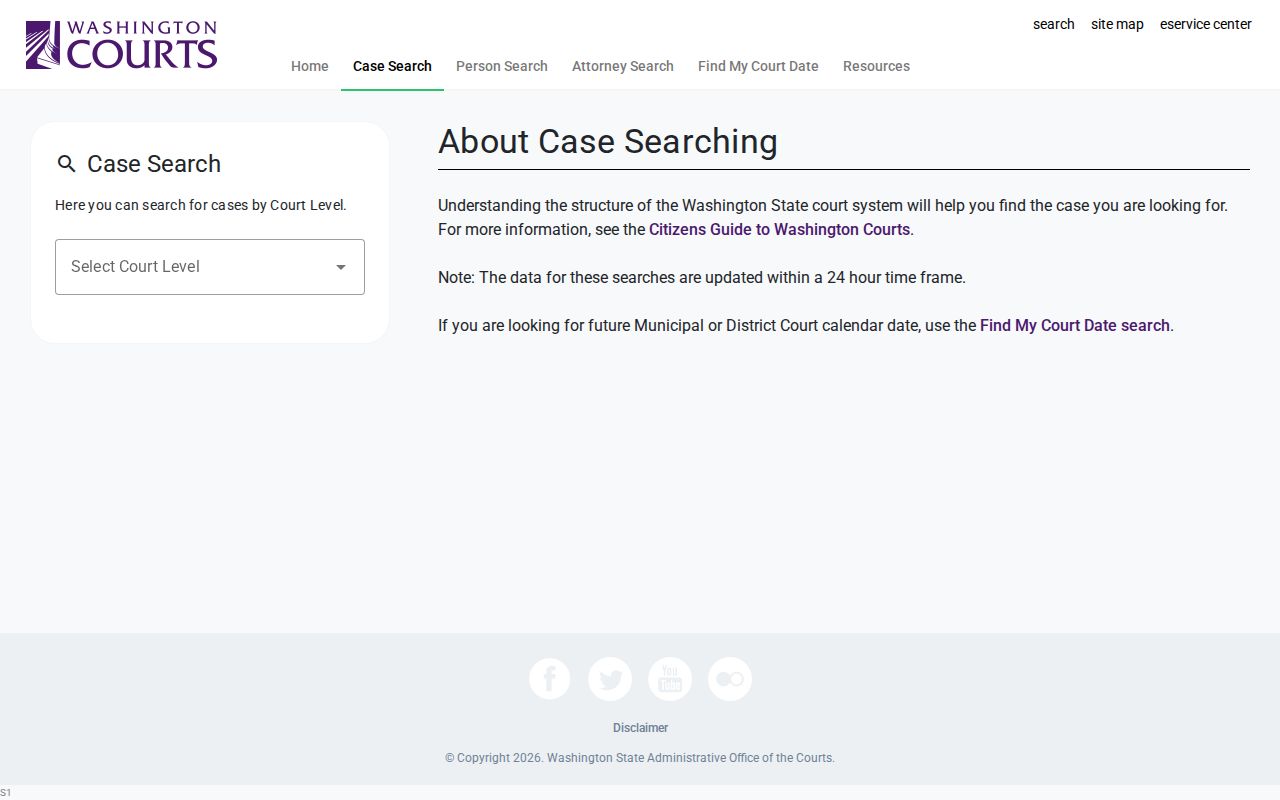
Think of that form as a wide first net for a Thurston County court docket. It can surface a likely criminal case and its number. It still does not stand in for the official court file the clerk keeps.
Two Thurston County Criminal Docket Paths
The two clerks trip up a lot of searches. Felony records live with the Thurston County Clerk in Superior Court. Misdemeanor and gross-misdemeanor records answer to the District Court Clerk. Both feed the same statewide index, yet their document channels stay separate. A Superior cause number can carry you from Odyssey straight to a County Clerk copy request. District criminal records, though, differ. They may need the county electronic link or a direct records request instead.
| Court | Criminal docket | Official follow-up |
|---|---|---|
| Superior Court | Felony cases and Superior criminal proceedings | Odyssey, then County Clerk |
| District Court | Misdemeanors and gross misdemeanors | District electronic records or request |
| Yelm Municipal Court | Yelm ordinance misdemeanors and infractions | Municipal court contact |
District electronic files ask for the cause or citation number. Criminal matters also need a three-character agency code. Common codes include WSP, THC, and LYP. The county cautions that an electronic file may leave out the event docket, so a direct request can still be the way in.
Criminal Dockets: What They Show
A criminal docket is a timeline. Odyssey labels its event view the Register of Actions, and it splits out case information, parties, disposition events, events, and hearings. Read those pieces side by side. An arraignment marks a stage. A motion entry is only a request, and a trial date on the schedule proves nothing about whether the trial happened. For real weight, look to a signed order or judgment rather than a short index label.
| Cause Number | The court identifier that joins the index, calendar, and copy request. |
|---|---|
| Charge | The filed allegation and count information, not by itself a conviction. |
| Register of Actions | The dated list of filings and court events. |
| Hearing | Date, event type, officer, courtroom, or remote-setting detail. |
| Disposition Event | An outcome entry read in context for the case or count. |
| Document | A filed complaint, motion, order, judgment, or sentence form. |
Words like continued, stricken, dismissed, sentenced, and closed each carry their own scope. A dismissal may cover just one count. A continuance shifts an event without ending the case. When the label leaves you guessing, pull the underlying document.
Reading Thurston County Criminal Calendar Labels
Thurston County groups its criminal calendar into families: preliminary appearances, arraignments, plea and sentencing settings, motions, trial confirmation, competency issues, treatment review, and Drug Court. Keep the exact label intact when you copy it. Trial confirmation is about readiness and scheduling. Sentencing follows its own disposition path. Competency and treatment-review entries speak to legal or treatment status, and neither should shrink to a bare date. The official criminal calendar shows how these events are grouped.
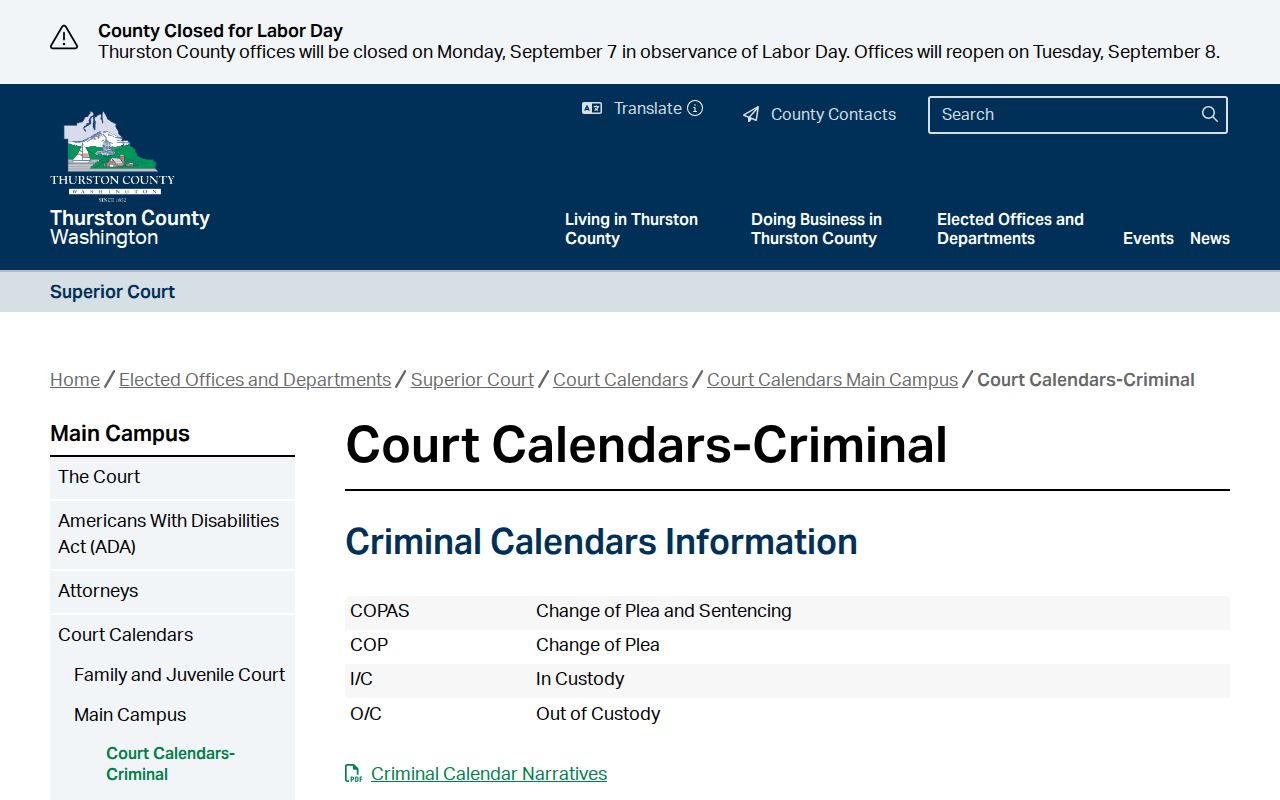
Calendars schedule; they do not decide. A listed motion or hearing can be continued, stricken, or moved, so check the case docket itself before relying on any setting.
- Preliminary appearance
- An early hearing that does not decide guilt.
- Arraignment
- The charge is addressed and a plea may be entered.
- Trial confirmation
- A readiness check before a planned trial.
- Stricken
- A setting removed from the calendar, not necessarily a dismissed case.
Criminal Case Stages on the Docket
The first public entry varies by case and court. From there, a Thurston County criminal docket may show arraignment, pretrial settings, motions, plea activity, trial settings, disposition, and sentencing. Some cases wrap up before trial. Others pick up competency review, treatment review, or a specialty-court track. Anchor each step to its own date and event text. Never backfill it from a later status label.
Docket flow: Filing › Arraignment › Pretrial › Plea or Trial › Disposition › Sentencing
Joining specialty treatment does not wipe the base docket. Drug Court reviews can be set at contract signing. They can also be set at later review points. Trial dates may be stricken when someone enters the program. Remember that program schedules describe court operations, not a public list of participants.
Confirming a Thurston County Criminal Setting
A current hearing calls for a current source. The Superior Court main-campus calendar posts session availability. It also covers daily courtroom assignments, remote-hearing details, holidays, and confirmed criminal trial lists. A closed session often means the calendar is full, not that no hearing exists. A judge can still add a matter by order. To bridge a posted calendar and the right criminal docket, the case number is your best tool. The Superior Court calendar hub carries the wider scheduling context.
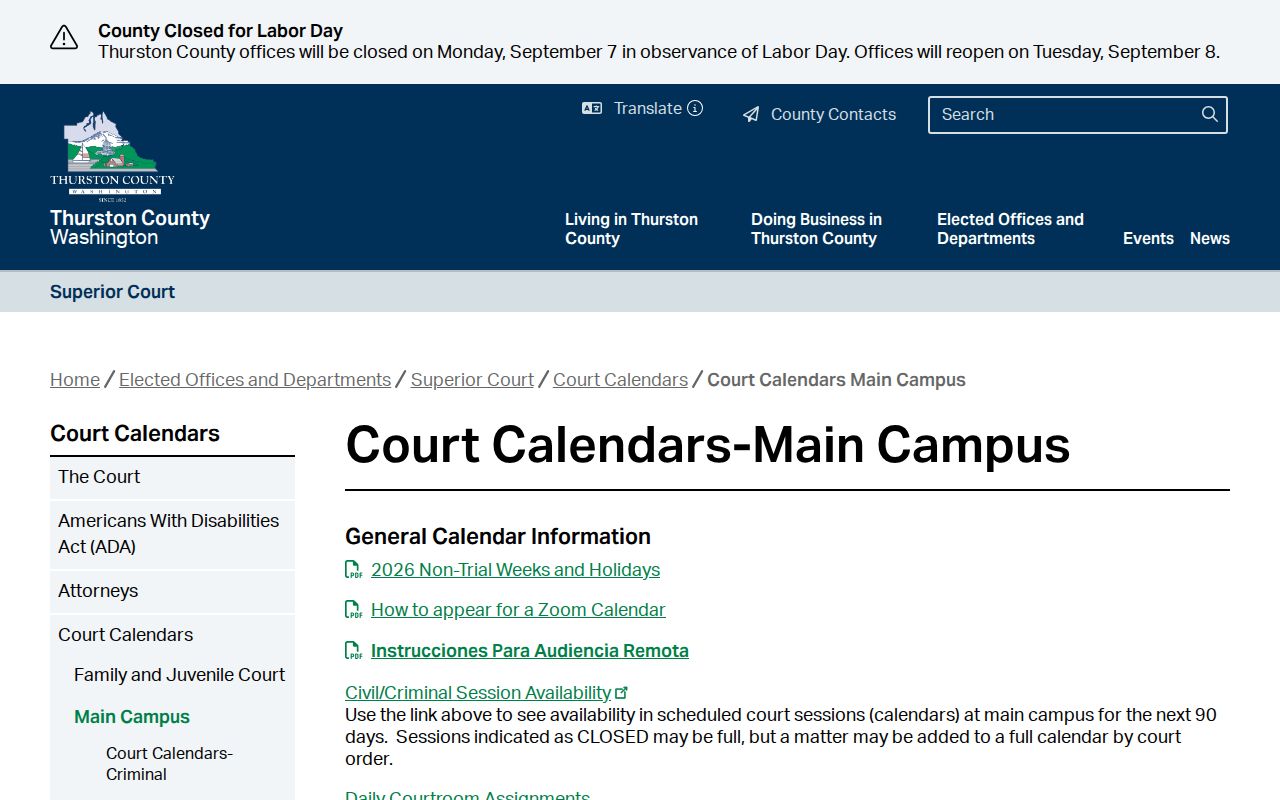
Set the calendar beside Odyssey hearings and the newest case event. If they clash, note when each was checked and call the court of record for the answer.
Note: A future setting proves only that an event was scheduled when checked, not that the event occurred.
Thurston County Criminal Docket Courts
Thurston County splits criminal dockets between two courts. Felonies live in Superior Court, where the County Clerk keeps the file. Misdemeanors and gross misdemeanors go to District Court unless a city court has them. Yelm runs its own Municipal Court. Matters from Olympia, Rainier, Tenino, and Bucoda land in District Court. Current Lacey cases land there too, under the official arrangements.
Know the split before you search. Superior case and hearing information is free through Odyssey. Public document images stay off that internet search, though. To see documents, use Clerk terminals, buy them through Clerk Documents, or ask by email or mail. District Court takes a case-record form or a mail request. It answers record questions by phone at 360-786-5450 and routes criminal email through TCDC@co.thurston.wa.us.
Criminal Record Custodians
Superior: Thurston County Clerk, 2000 Lakeridge Drive SW, Building 2, Olympia, WA 98502
District: Thurston County District Court, Building 3, Olympia, WA 98502-6045
Clerk: 360-786-5430 | District: 360-786-5450
Thurston County Criminal Docket Copies
A docket index entry answers one question. A plain image and a certified copy each answer others. For a Superior criminal file, register for Clerk Documents. Search by cause number and preview what is there. Then order the exact filing. The County Clerk also takes requests at tcclerk@co.thurston.wa.us or by mail. Give the case number or name plus the documents you want. A mailed request needs a cashier's check or money order and a stamped return envelope.
The fees differ by court. Noncertified Superior copies run $0.50 per page. Certification costs $5 for the first page and $1 for each added page per document. District Court charges $5 per certified document and $20 per CD of proceedings. Its request form asks for the defendant's name and case number. It also wants the document, and whether you want certification. Staff will not hunt for a missing case number on your behalf.
| Channel | What it provides | What to supply |
|---|---|---|
| Odyssey | Free Superior case and hearing data | Cause number or party name |
| Clerk terminal | On-site public viewing | Cause number and document |
| Documents, email, or mail | Superior copies and certification | Case and exact filings |
| District request | Files, dockets, calendars, orders | Case number and records |
Thurston County Criminal Docket Workload
How busy is this docket? The 2024 Washington Courts annual report lists 15,757 Superior criminal proceedings in Thurston County. Count proceedings, not people. That figure is not a tally of unique defendants, cases, convictions, or web records, since one case can generate several proceedings, and it leaves most District and municipal events out of the total.
Keep searches narrow in Odyssey. Add Thurston County, a case type, a date range, or a full number. A trailing wildcard is allowed, but wildcard and Soundex cannot be combined, so save your settings if you plan to repeat the search.
Access Rules for Criminal Dockets
Washington lets the public inspect court records. Yet the public view is never the whole file. Sealed records, confidential documents, protected identifiers, and juvenile material may be withheld or redacted. GR 31 keeps official juvenile-offender court information off ordinary public websites. A party can use Thurston County's appointment route for certain confidential documents. That is not a public workaround around a sealed file.
One empty result does not mean a record is sealed. Check the court level, spelling, year, city route, and cause number first. Then ask the clerk whether a rule or an order controls access. A charge, warrant event, preliminary appearance, or hearing is not a conviction. So verify any disposition through context and the signed order when it matters.
Key Rules:
Washington GR 31 governs public access, free courthouse inspection, redaction, and juvenile website limits.
Washington GR 15 and Thurston LGR 15 govern sealing, destruction, and redaction.
RCW 13.50 sets the juvenile confidentiality and sealing framework.